


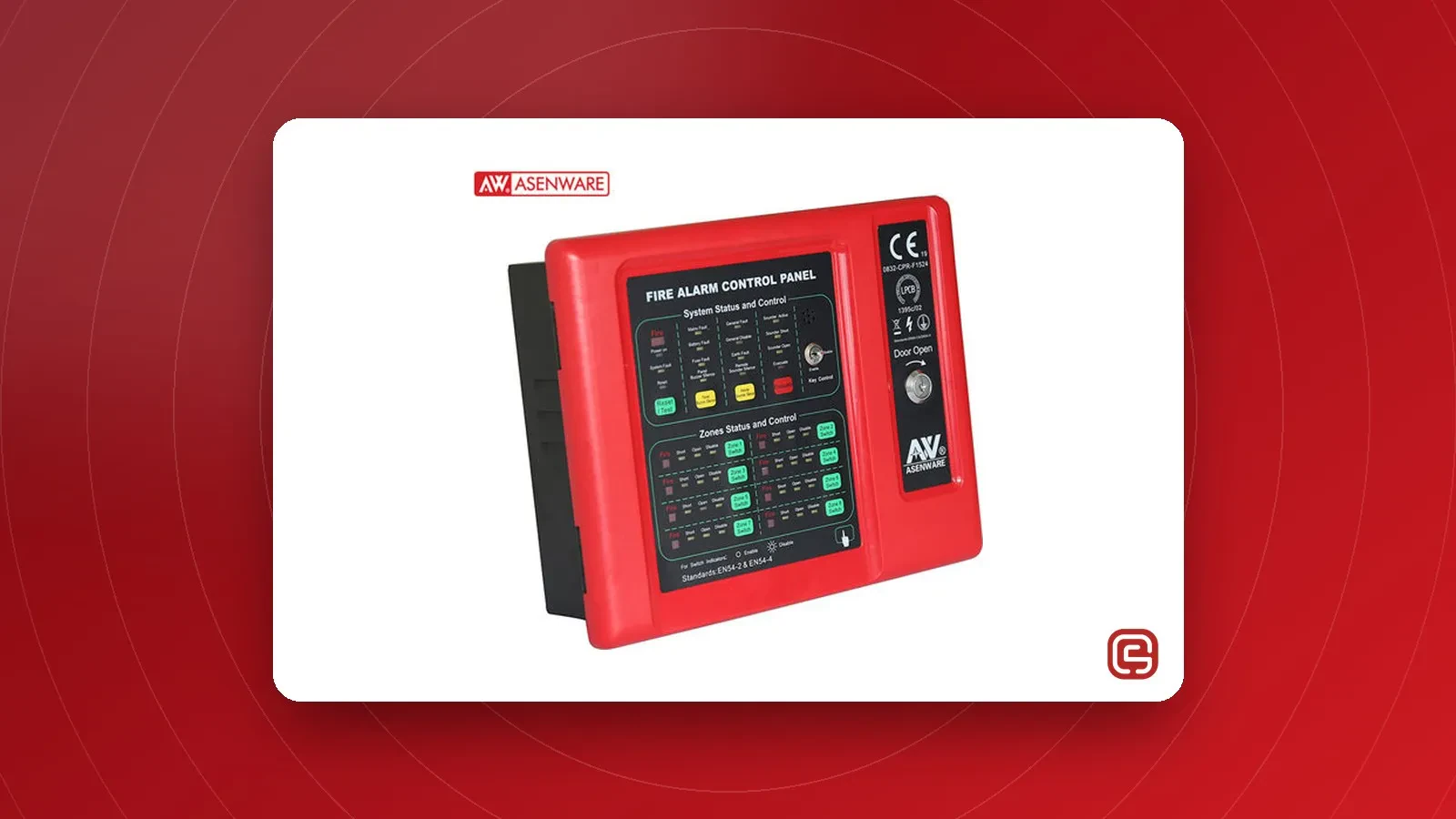
Not all fire alarm panels work the same way. Understanding the difference between conventional and addressable lets you offer the customer the system suited to their building, neither undersized nor needlessly expensive.
The conventional system: simple and economical
Detectors are grouped into zones (one loop per zone). In an alarm, the panel indicates the zone concerned, for example "Zone 3: storeroom", but not the exact detector. Asenware conventional panels come in 2, 4, 8 or 16 zones.
- Strengths: detector price, quick commissioning, no address programming.
- Limits: star cabling (one loop per zone), approximate location, extension limited to the panel's number of zones.
- Typical use: shops, small offices, medium-sized schools, workshops, up to a few dozen detectors.
The addressable system: every point identified
Each detector, call point or module carries an address on a shared loop. The panel displays precisely "Detector 47, 2nd floor corridor" and monitors the status of each point (contamination, fault, removal). Addressable panels manage hundreds of points on one or more loops.
- Strengths: immediate location, loop cabling (less cable), pre-alarm and drift compensation, input-output modules to control fire doors, ventilation and lifts.
- Limits: more expensive equipment per unit, programming required, operator training.
- Typical use: hotels, clinics, office buildings, factories, logistics warehouses, any site with several levels or long corridors.
Decision criteria
| Criterion | Conventional | Addressable |
|---|---|---|
| Number of points | Up to 30 to 50 | 50 to several hundred |
| Location | By zone | By detector |
| Cabling | One loop per zone | One shared loop |
| Scalability | Limited | High |
| Equipment budget | Low | Medium to high |
Do not forget
Whatever the system, the alarm must be audible everywhere (sounders and beacons), manual call points must be placed on escape routes, and the cable must be fire-rated (fire-resistant cable for sounders and controls). The equipment we distribute is EN 54 certified; we provide certificates on request.
Published by GSS Distrib
Share on WhatsAppRead next

Which fire extinguisher for which premises: home, shop, workshop, warehouse?
Weight, extinguishing agent, number of units: practical recommendations room by room and sector by sector, alongside our guide on powder, CO₂ and maintenance.
Telephone dialler and remote monitoring: how to be alerted in case of an alarm
PSTN, GSM, IP, mobile app or alarm receiving centre: the options for transmitting an alarm remotely, their limits, and how to choose according to the site.

Alarm sounders: indoor, outdoor or standalone, how to choose and position them
Deterrence, sound coverage, tamper protection, autonomy: the criteria for choosing the right combination of sounders and avoiding the classic weak points of an installation.